Showing posts with label smoking ordinances. Show all posts

Thursday, November 20, 2014

Ky. Rural Health Association backs statewide smoking ban

The Kentucky Rural Health Association is asking Kentuckians to contact their legislators and advocate passage of a statewide smoking ban in the 2015 session of the General Assembly.

KRHA Executive Director Tina McCormick writes, "Smoke-free laws have been unmitigated and popular successes here in Kentucky at the local level and virtually everywhere they have been implemented. Comprehensive laws protect everyone equally, achieve nearly universal compliance, and improve air quality and the health of workers almost immediately." To read McCormick's article, click here.

Friday, September 5, 2014

Study shows tailored advocacy for local smoking bans in rural Kentucky gets results

Local smoking bans are only possible if the community is ready for this change, Ellen Hahn, director of the Kentucky Center for Smoke-free Policy, writes in a report of a five-year study she conducted in rural Kentucky.

Readiness for change can be developed in rural communities that participate in smoke-free policy initiatives tailored to their community, Hahn writes in The Journal of Rural Health. The study evaluated six stages of readiness to determine if a community was ready to support smoke-free policy, and then tailored interventions based on how ready the community was.

The study was conducted in 37 rural Kentucky counties that were randomly selected from those without smoking ordinances or regulations. Nineteen of the communities received policy-intervention strategies, tailored to their readiness, from a trained community adviser. The remaining 18 were used for comparison. Data were collected annually and policy outcomes were tracked over five years.

Nearly one-third of the counties that were the target of interventions adopted smoking bans covering restaurants, bars, and all workplaces, while none of the comparison counties did.

Rural, tobacco-growing areas were chosen because they are "disproportionately affected by tobacco use, secondhand smoke, and weak tobacco control policies," Hahn writes in the study, "A Controlled Community-Based Trial to Promote Smoke-Free Policy in Rural Communities."

Wednesday, August 27, 2014

Health-board smoking bans that Supreme Court struck down are still being obeyed: 'Everybody loves it,' advocate says

By Melissa Patrick
Kentucky Health News

Three counties in Kentucky with unenforceable smoking bans continue to be smoke-free by the people’s choice.

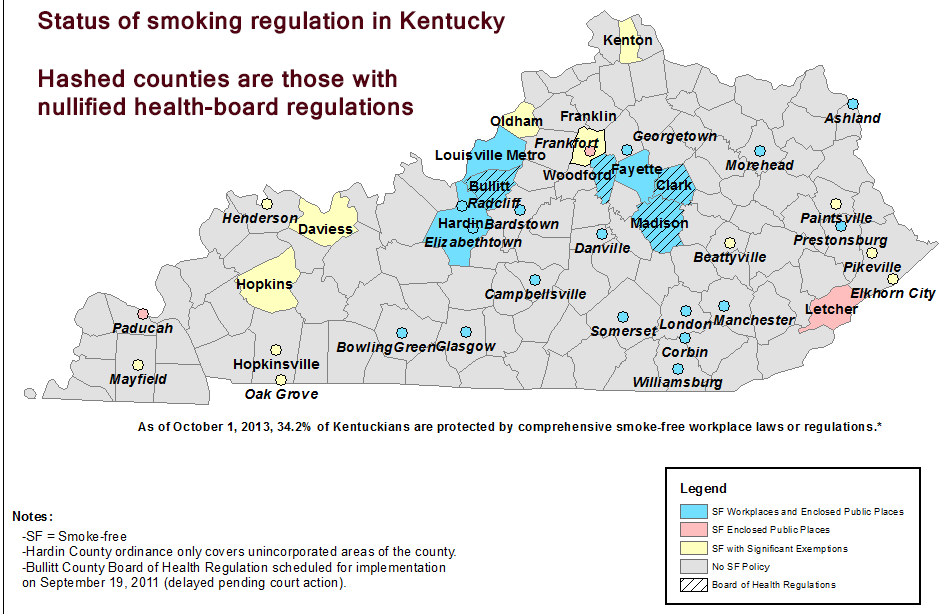
Clark, Madison and Woodford counties have smoking bans that can’t be enforced because they are regulations of county health boards, which the Kentucky Supreme Court ruled in June do not have the power to ban smoking in public places. But officials in each county reported that most of the establishments in these counties continue to be smoke-free by choice.

“We are finding, in general, public spaces and restaurants are still complying with regulations as if it is still enforceable,” said Christie Green, public-information officer for the Madison County Health Department. “It seems as if the general public prefers this.”

In Versailles, the city council “hadn’t heard from one single tax-payer who is opposed to it,” recently resigned city council member Sonny Jones said in an interview before his resignation.

Scott Lockard, director of public health in Clark County, said likewise. “The community has remained smoke free. The public has demanded this, ” he said, and as far as he was aware “No businesses have gone backward in this.”

That doesn’t surprise Ellen Hahn, director for the Kentucky Center for Smoke-Free Policy and the state’s leading smoking-ban advocate. “When communities go smoke free, everybody loves it,” she said.

The anti-smoking regulations can’t be enforced, advocates said. “If enforced, a lawsuit might result,” Lockard said. “We have no active enforcement right now in Clark County.”

The court ruled in a case from Bullitt County, where a local judge had blocked enforcement.

Each of the other counties is handling the issue somewhat differently.

Woodford County, out of “respect for the cities” of Midway and Versailles, will let them determine whether they want to reinstate their previously enacted smoking bans before the county fiscal court makes a decision for the unincorporated area of the county, County Attorney Alan George said, “because the bulk of the affected business is in the city.”

Midway passed a new anti-smoking ordinance Aug. 18 and Versailles plans to hold its first reading on one Sept. 2.

Madison County plans second reading and passage of its smoking ordinance for Sept. 9. Berea is scheduled to do likewise Sept. 2.

Clark County has “no forward actions” or “no ordinance drafted” at this time, Lockard said. Asked if officials are waiting on the Nov. 4 election to move forward, he said that “no one had come out and said the election will play a role,” but he noted that the Winchester mayor and the county judge-executive have opponents.

The Supreme Court ruling was a great disappointment to smoke-free advocates. Betsy Janes, coordinator for Smoke Free Kentucky, said several health boards had been ready to implement smoke-free regulations, but were waiting on the Supreme Court. These plans obviously have had to change.

“It was a major blow, but the good thing is that it is very clear who has the authority to do this now,” Janes said. “Fifty-five percent of Kentuckians want to be smoke free. We are losing 1000 Kentuckians a year to second hand smoke,” based on research that has determined its effects.

While Hahn said the decision was a “step backwards for Kentucky,” she also said her center is “busier than ever” working with fiscal courts to create smoke-free laws on the local level. She said there are 35 city or county ordinances in effect, covering 31 percent of Kentuckians.

The Kentucky Chamber of Commerce supports statewide smoking ban, which has never come to a vote in either chamber of the legislature.

“Twenty-four other states have statewide smoke-free laws and we want to not be the last to join them,” said Ashli Watts, the chamber’s public-affairs manager.

While Clark County is not pursuing a smoke-free ordinance now, the health department is actively educating the public about the benefits of such laws and plans to be a strong advocate to get something passed, Lockard said.

“We are finding overwhelming positive response to smoke-free,” he said. “The Board of Health and health department will work in any way possible to get a law on the books.”

Lockard also voiced his hope that school boards will pass smoke-free policies in schools, which he said should be attainable because no legislation is needed.

“There are 174 school districts in Kentucky and less than 40 of them have smoke-free policies on their campuses,” Lockard said. “If we could have all schools smoke-free, that would have a major impact on our communities.”

Lockard reflected on what Tom Frieden, director of the federal Centers for Disease Control and Prevention, said in his recent visit to Kentucky, that the most important changes Kentuckians need to make to improve their health are to stop smoking, decrease secondhand smoke exposure, and to exercise.
Friday, August 22, 2014

Owensboro commissioners drop pre-existing bars from draft of smoking-ban ordinance

The Owensboro City Commission compromised to gain the support of all five members to vote for a smoking ban, which will come up for a vote on Sept. 2, Steve Vied reports for the Owensboro Messenger-Inquirer.

The original draft of the ordinance eliminated smoking in all public places in the city, and was favored narrowly. The compromise allows smoking to continue in establishments that are already in operation and don't allow entry to anyone under 18, thus exempting bars, as a county ordinance does.

"New bars that open after the ordinance goes into effect, whether they allow customers under 18 or not, will not be permitted to have smoking," Mayor Ron Payne said.

"Thank you so much," said Ashley Oberst, an employee of Rocky's Bar and Grill at Ninth and Crittenden streets. "It means more than you know."

"I'm not here to make choices for adults," Commissioner Jeff Sanford said, but if smoking "is around kids, I can't support it."

Payne told the audience at a meeting, "First and foremost, this commission wants to act in unison. We did not want a split vote. No. 2, we have listened to you. You made some good points that we have considered. We all have wrestled with this. This is a toughie. I have three younger brothers, all gone, two from lung cancer."

The new version also deleted regulation of electronic cigarettes. (Read more; this article is behind a paywall)

Monday, July 7, 2014

'This kind of sloppy defiance reeks of a Podunk attitude,' Hopkinsville paper says after fair doesn't enforce smoking ban

It's been a while since we read an editorial as clear, blunt and well-taken as the one the Kentucky New Era ran about the flouting of Hopkinsville's smoking ban at the Western Kentucky State Fair, so here it is, in its entirety:

The Hopkinsville ordinance that bans smoking at most indoor public places is not enforced at the Western Kentucky State Fairgrounds convention center. That became clear last week during the fair. Despite assurances from the fair board’s leadership that smoking ban violations would be addressed, at least a few people continued to smoke cigarettes throughout fair week inside the convention center.

This is a shame on so many counts.

First, it makes a joke of the smoking ban that is intended to ensure the city’s indoor public places are healthier for everyone, especially for children and for adults who don’t smoke and don’t want to be exposed to secondhand smoke. If the fair board cannot get in line with a smoking ordinance 18 months after it went into effect, why should any store, office or restaurant in the city that’s opposed to the ban go along with it?

Second, by refusing to enforce the ban, the fair board is ignoring the fact that hundreds of people who do not smoke and do not want to be exposed to secondhand smoke will now see the convention center as one of the most undesirable places in the city. It seems to say something about the fair board’s opinion of the building. Is it that negative?

Third, the smoking violations put the fair board in conflict with the no-smoking signs the board itself must have authorized for the building’s front and rear doors. What was the purpose of the signs? It looks like window dressing to anyone who passes the threshold and then finds someone smoking in the middle of the building in the middle of the day.

Fourth, the smoking violations put the fair board in conflict with city government. The convention center and the fairgrounds are inside city limits. The smoking ban applies to the convention center. The building is not an island or a special place set off to itself.

During fair week, the convention center is one of the most public places in the city. Thousands of people, including children, pass through the building for pageants, talent shows and gardening and home goods competitions.

The fair board ought to play by the rules and respect the process that resulted in Hopkinsville City Council’s approval of the smoking ban.

If the fair board won’t obey the ordinance, city officials need to enforce the ban. If they don’t, they will risk having more people behave as if the law does not apply to them.

This kind of sloppy defiance reeks of a Podunk attitude.

That’s not the reputation Hopkinsville wants or deserves.

Wednesday, June 18, 2014

Foundation for a Healthy Kentucky reports putting 24 percent more money into grants last year than in 2012

The Foundation for a Healthy Kentucky made grants totaling $2,355,838 in 2013, a 24 percent increase over the 2012 total of $1,903,660, according to the annual report it released yesterday.

Last year was the first in which the foundation made grants for two major initiatives: Investing in Kentucky's Future, which it calls "a $3 million commitment to seven Kentucky communities where civic leaders have come together and committed to a process and a plan for collective impact on the future health of their children," and Promoting Responsive Health Policy, which tries to see that voices of under-represented populations are part of the health-policy conversation in Kentucky.

The first initiative's seven grantees are Fitness for Life Around Grant County, the Clinton County Schools (for the Healthy Hometown Coalition), the Foundation for Appalachian Kentucky (for the Perry County Health and Wellness Coalition), the Green River Area Development District (for the Partnership for a Healthy McLean County), the Kentucky Heart Foundation (for work in Boyd and Greenup counties), Kentucky River Community Care (for the Breathitt County Health Planning Council for Children) and the Louisville Metro Department of Health and Wellness (for the Coalition for Louisville Youth).

Under the policy initiative, the report says, grantees "are working to improve access to needed health care, support children's health, strengthen local public health and "increase the number of Kentuckians living in communities where workplaces are smoke-free." For a complete list of grants made by the foundation in 2013, click here. For a January press release about them, click here.

The foundation was established in 2001 to settle a lawsuit by then-Attorney General Ben Chandler against Anthem Inc. to recover the charitable assets that Anthem had gained in its merger with the old Kentucky Blue Cross/Blue Shield. The foundation's net assets grew to nearly $56.4 million last year, a 7.7 percent increase over the end of 2012.

The foundation is a non-profit philanthropy with a mission of addressing the unmet health-care needs of Kentuckians. It has invested more than $24 million in health-policy research and pilot-project grants that invests in communities and informs health policy through grant making, research and education. It says it is "committed to improving access to care, reducing health risks and disparities and promoting health equity."

The foundation also acts as a convener, through its annual Howard L. Bost Health Policy Forum, its "Health for a Change" workshops and webinars, funding of conferences held by others and meeting space at its new offices in eastern Jefferson County for more than 21 community and statewide organizations.

It also acts as a communicator, through its annual Kentucky Health Issues Poll and other research, and it funds independent health reporting by Kentucky Educational Television and the Institute for Rural Journalism and Community Issues in the School of Journalism and Telecommunications at the University of Kentucky, which publishes Kentucky Health News.

Monday, May 26, 2014

Tobacco heritage blocks smoking bans in rural Kentucky

"A mural showing a tobacco harvest has been on display high in
the second-floor rotunda of the Bourbon County Courthouse for
than 100 years," Mary Meehan writes. (Herald-Leader photo) 

Bourbon County's strong tobacco heritage is the main obstacle for proponents of a local smoking ban, and similar feelings exist in many Kentucky counties, Mary Meehan reports for the Lexington Herald-Leader in the second of a series of stories about tobacco use in Kentucky.

"At an April political forum at Bourbon County High School, cigarette butts lined the walkway to the auditorium, although the campus is designated smoke-free," Meehan writes. "Onstage, candidates for city council and magistrate were asked whether they would support a smoking ban. Some said they had fathers or sisters who were longtime smokers who had cancer, most said they didn't smoke, and a few said they weren't sure smoking was really a health risk. Of 18 candidates, only one said he would support a smoking ban. He didn't win in last week's primary election."

The forum was organized by Students Making a Change in Our Communities, a youth group advocating a smoking ban. They have helped rejuvenate efforts begun three years ago by the Coalition for a Smoke-Free Bourbon County and Cyndi Steele, health coordinator for the Bourbon County Health Department.

"Twelve of Kentucky's 120 counties and 26 cities have enacted some type of smoke-free ordinance," Meehan notes. "In Kentucky, 34 percent of the population is protected by smoke-free laws. Almost all Kentucky cities with bans are county seats, leaving most of rural Kentucky without smoking regulations. Efforts to enact a statewide ordinance have failed in the legislature.

"Across the country, about half the population lives in places with smoke-free rules, said Cynthia Hallett, executive director of the nonprofit Americans for Nonsmokers' Rights. She said the science on the dangers of smoking and exposure to secondhand smoke was clear, as were the benefits of smoke-free laws. Kids who grow up where smoking is banned in public places are less likely to smoke, she said. People tend to quit when towns go smoke-free." (Read more)

Read more here: http://www.kentucky.com/2014/05/25/3259432/bourbon-countys-tobacco-heritage.html?sp=/99/322/&ihp=1#storylink=cpy
Read more here: